
Straight to the Point
- The Super Bowl remains the annual milestone to reach American audiences at scale, but shared visibility doesn’t produce shared meaning
- What audiences already believe about a company’s brand determines whether an ad builds credibility or fuels an inevitable conversation based on skepticism
- Reputation grows when companies tell a story that’s consistent with their character in ways that resonate with the nation’s character
What We See
It’s fair to be skeptical of Super Bowl ad analysis. Every year, the choices made by companies that are distilled and reflected in :30 and :60 bursts are framed as a cultural referendum. Every year, brands are told it means more than ever.
And today, it still does.
Now that we’re two weeks past the game and the traditional ad rankings have run their course, we can examine what the game actually left us with.
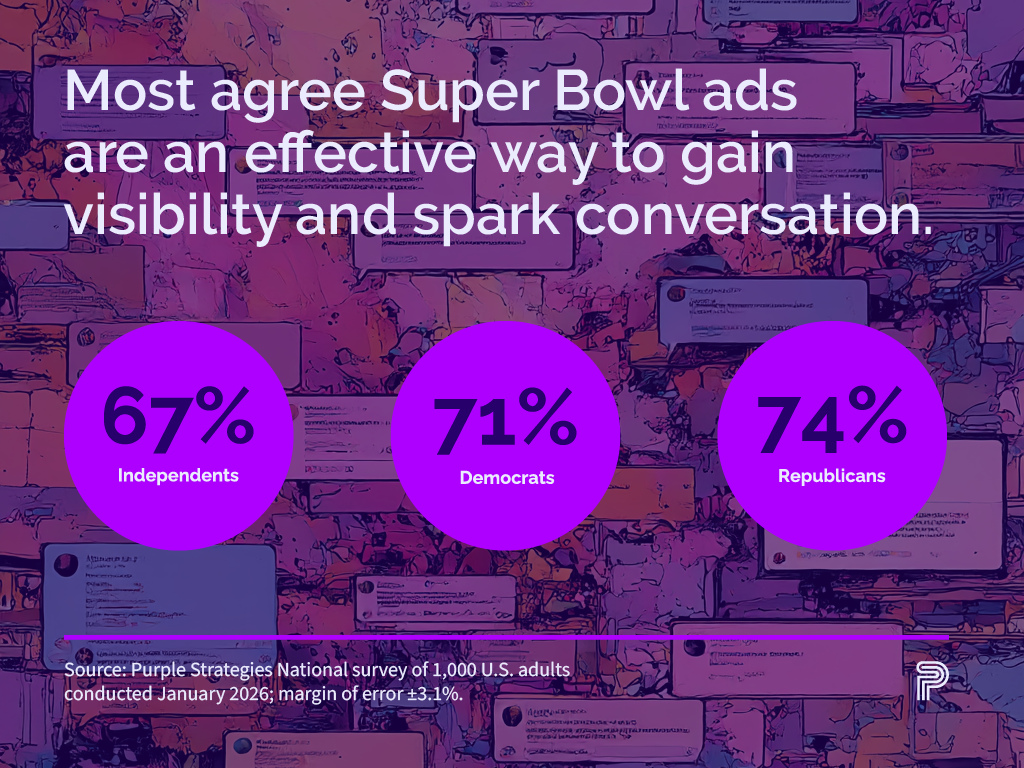
Our research conducted prior to the game showed rare agreement across political identities that the Super Bowl remains a powerful tactic for brands. Seven in ten Democrats (71%), two-thirds of independents (67%), and nearly three-quarters of Republicans (74%) agreed it’s an effective way to gain visibility and spark conversation.
Instead of critiquing and ranking ads, we stepped back to examine what it means to have a shared stage in a fragmented political culture — especially when the conditions surrounding this year’s Super Bowl were unusually charged.
Ahead of the game, some of the country’s most heated debates — around immigration, representation and national identity — surfaced unusually close to the event itself. Ads took on health care, the role AI should play in our lives and MAHA movement. At the same time, performances by artists like Bad Bunny and Green Day brought their own cultural and political resonance to a stage already under scrutiny. None of it sat in a neutral lane.
The result was not a single, shared cultural moment, but a collision of meanings.
People didn’t experience the Super Bowl as a unified audience. They experienced it through political identity, cultural expectation, personal experiences and accumulated skepticism. They watched the same ads, but they didn’t watch them the same way. What looks like a mass moment from the boardroom fractures quickly once it’s interpreted by the public.
[Read more: Reclaiming Trust When Under Fire]
What It Means
Reputation is built on consistency, not clicks. The test on this grand stage is unique: whether what shows up can withstand being seen, and interpreted, by everyone at once.
In mass moments like the Super Bowl, people aren’t suspending judgment. They are accelerating it. Audiences rely on what they already believe about a brand to interpret what they see: often in seconds, and rarely with the benefit of the doubt.
This is why reputation isn’t formed during the game. It’s tallied afterward.
The same message or symbol or minute production detail can reinforce trust with one group and deepen skepticism with another. Even the choice to opt out carries its own weight — not because the message changed, but because the audience’s interpretation did.
In this environment, inconsistency travels faster than persuasion. Attempts to appeal broadly are scrutinized for alignment, and intent is quickly inferred in character terms. Messages from a brand that feel disconnected from the company’s character are dismissed quickly — and remembered longer than carefully crafted appeals.
The risk isn’t controversy. It’s contradiction.
[Want to dive deeper into what this means for your business? Let’s talk.]
What To Do
This approach was on full display in one of this year’s most strategically sophisticated efforts. Lay’s didn’t just tell a brand story during the Super Bowl. They showed how to put these principles in action.
The regulatory threat was already brewing. The MAHA movement’s “eat real food” message put processed food companies directly in the crosshairs, ever since RFK Jr. aligned with President Trump during the campaign in 2024.
Lay’s response was strategically brilliant. On one level, it’s a timely effort to refresh the brand and reassure America that it deserves the benefit of the doubt when it comes to the quality of the food. It’s simple. Its basic ingredient comes from the ground, harvested by farmers. To the extent it’s processed, it’s minimal, certainly not “ultra.” The story of an archetypal, empathetic and noble supplier, an American farmer family, anchors the quality, heritage and character components of the brand.
While it worked as brand advertising, it also functioned as a timely effort to remind sets of eyeballs measured in the dozens and residing in Washington, that they’d better tread lightly. The HHS exhortation to “eat real food,” if accompanied by restrictive regulatory action, changes the ending of this story. Much fewer bags of potato chips are sold, much fewer potatoes are harvested with care, and much fewer family farms like this get passed to the next generation. This ad is also for the leaders of HHS, USDA and, ultimately, the White House as they perform the complicated calculus of creating policy that protects America’s iconic farmers and policy that puts teeth into a largely popular American health agenda. These agendas are more mutually exclusive than mutually reinforcing. And where this game nets out will help decide the midterm election. This ad is an emotionally resonant reminder of that fault line, and it was done in front of 130 million people.
Back to outcomes: an enhanced brand reputation and, more critically for the business, food policy that preserves their license to operate. The takeaway: find the people in your corner who your critics actually care about, then put them front and center. Regulators might dismiss Lay’s, but they can’t dismiss family farmers.
 Patients Aren’t Patient Anymore
  Washington’s New Normal: Why the Old Advocacy Playbook No Lo...
  Reclaiming Trust When Under Fire